What is Form 1099-MISC?
Form 1099-MISC is an IRS information return for miscellaneous business payments. You file it when you make certain types of reportable payments in the course of your trade or business and the amount reaches the applicable threshold.
MISC stands for Miscellaneous Information. The form has been around in various forms for decades, and it once covered nearly everything. Since 2020, nonemployee compensation moved to its own form, Form 1099-NEC. What remains on the 1099-MISC is a specific set of payment categories, each with its own box and in some cases its own threshold.
Do not use Form 1099-MISC to report payments to independent contractors for services. Those go on Form 1099-NEC, Box 1. Filing contractor service fees on 1099-MISC is one of the most common 1099 errors and creates a mismatch in IRS records.
Who files a 1099-MISC?
Any business, nonprofit, or government agency that makes a reportable payment covered by the form and meets the applicable threshold must file. Personal payments are not reportable. The payment must be made in the course of your trade or business.
You file a 1099-MISC for the payee and send a copy to the IRS. The payee uses their copy to report the income on their own return.
What are the reporting thresholds for the 2026 tax year?
The One Big Beautiful Bill Act (OBBBA), signed July 4, 2025, raised the general reporting threshold from $600 to $2,000 for payments made starting in the 2026 tax year. Two boxes retain lower thresholds that were not changed by the OBBBA.
- $2,000: Applies to Boxes 1, 3, 6, 9, 10, and 11 for the 2026 tax year. Beginning with the 2027 tax year, this amount adjusts annually for inflation.
- $10: Applies to Box 2 (royalties) and Box 8 (substitute payments in lieu of dividends or interest). These thresholds are set separately by statute and were not changed by the OBBBA.
- Any amount: Box 4 (federal income tax withheld under backup withholding) must be reported regardless of the total payment amount.
The $2,000 threshold applies per payee, per calendar year. Add up all qualifying payments in a given box for a given payee across the entire year. If the total reaches $2,000, file a 1099-MISC.
Box-by-box reference
Each box on Form 1099-MISC covers a specific category of payment. Here is what goes in each one.
| Box | Label | What it covers | Threshold |
|---|
| Box 1 | Rents | Office space, equipment, machinery, land, pasture, coin-operated amusements | $2,000 (2026 tax year) |
| Box 2 | Royalties | Patents, copyrights, trademarks, oil, gas, and other mineral properties | $10 |
| Box 3 | Other income | Prizes and awards not for services, barter income, deceased employee wage payments, other taxable income not reported elsewhere | $2,000 (2026 tax year) |
| Box 4 | Federal income tax withheld | Backup withholding remitted to the IRS | Any amount |
| Box 5 | Fishing boat proceeds | Each crew member's share of proceeds from a fishing boat operator | Any amount |
| Box 6 | Medical and health care payments | Physicians, nurses, hospitals, clinical labs, and other health care providers. Applies even to incorporated providers. | $2,000 (2026 tax year) |
| Box 7 | Payer made direct sales of $5,000 or more | Checkbox only. Check if you sold $5,000 or more of consumer products to the recipient for resale. No dollar amount entered. | $5,000 (checkbox trigger) |
| Box 8 | Substitute payments in lieu of dividends or interest | Broker payments made to a customer in lieu of dividends or tax-exempt interest when securities are on loan | $10 |
| Box 9 | Crop insurance proceeds | Payments by an insurance company to a farmer, unless the farmer capitalized expenses and notified the insurer | $2,000 (2026 tax year) |
| Box 10 | Gross proceeds paid to an attorney | Settlement funds or other proceeds paid to a law firm in connection with legal services, where the money is not for the attorney's own fees. Applies regardless of corporate structure. | $2,000 (2026 tax year) |
| Box 11 | Fish purchased for resale | Cash payments for fish or other aquatic life purchased from a person in the trade or business of catching fish | $2,000 (2026 tax year) |
| Box 15 | Nonqualified deferred compensation | Current-year deferrals under a nonqualified deferred compensation plan subject to IRC section 409A | Any amount |
| Boxes 16-18 | State and local tax information | State tax withheld, payer's state ID number, and state income where state reporting is required | Per state requirements |
Boxes 12, 13, and 14 are reserved or used for specific technical purposes including FATCA reporting. Box 14 is now reserved for future use following the move of excess golden parachute payments to Form 1099-NEC Box 3 starting with the 2026 tax year.
Box 1: Rents
Report rental payments for office space, equipment, storage units, machinery, land, and pasture. The payment must be made in the course of your trade or business and must go directly to the property owner or lessor.
If you pay rent to a real estate agent or property manager rather than directly to the property owner, you do not file a 1099-MISC. The agent handles reporting to the owner.
Rents paid to corporations are generally exempt from 1099-MISC reporting, with the exception of payments meeting other reportable criteria. Confirm the payee's tax classification using their W-9 before filing.
Box 2: Royalties
Report gross royalty payments of $10 or more for patents, copyrights, trademarks, and oil, gas, or other mineral properties. Surface royalties are not included here. Do not report oil or gas payments for a working interest in Box 2. Those go in Box 1.
The $10 royalty threshold was not changed by the OBBBA and remains at $10 for the 2026 tax year and beyond.
Box 3: Other income
Box 3 is a catch-all for taxable income that does not fit any other box. Common examples include:
- Prizes and awards that are not for services (a raffle prize, a cash award not tied to work performed)
- Barter income at fair market value
- Payments to deceased employees' estates or beneficiaries for accrued wages and vacation pay
- Indian gaming profits paid to tribal members
Prizes and awards paid for services belong on Form 1099-NEC Box 1, not here. Box 3 is specifically for non-service payments.
Box 6: Medical and health care payments
Report payments of the applicable threshold or more made to physicians, surgeons, dentists, nurses, hospitals, clinical laboratories, and other health care providers. This applies to both individuals and corporations. The corporate exemption does not apply to medical and health care payments.
Payments for goods and services are both included. A payment to a clinic that covers both a procedure and medications is reported in full in Box 6.
Three categories are excluded from Box 6:
- Payments to pharmacies for prescription drugs only
- Payments to tax-exempt hospitals and extended care facilities
- Payments under flexible spending arrangements (FSAs) or health reimbursement arrangements (HRAs) that qualify as employer-provided accident or health coverage
Box 8: Substitute payments in lieu of dividends or interest
This box is used by brokers, not most businesses. It covers payments a broker makes to a customer in place of dividends or tax-exempt interest when the customer's securities are on loan. The $10 threshold applies and was not changed by the OBBBA.
If your business is not a broker making substitute payments on loaned securities, this box does not apply to you.
Box 10: Gross proceeds paid to an attorney
Report gross proceeds of the applicable threshold or more paid to an attorney in connection with legal services, where the payment is not for the attorney's own fees. The most common example is a legal settlement where funds are paid to a law firm for disbursement to a claimant.
Box 10 and Form 1099-NEC Box 1 are separate and both may apply to the same attorney. Attorney fees for legal services go on 1099-NEC Box 1. Gross settlement proceeds flowing through the attorney go on 1099-MISC Box 10. If you paid the same law firm for both, you file two forms.
The corporate exemption does not apply to Box 10. Report gross proceeds to attorneys regardless of whether the firm is incorporated.
Which payments are not reported on 1099-MISC?
Several categories are explicitly excluded from 1099-MISC reporting even when payments are substantial:
- Wages, salaries, and tips paid to employees (reported on Form W-2)
- Contractor service fees (reported on Form 1099-NEC Box 1)
- Payments to corporations, except for the exceptions described above
- Payments made via credit card, debit card, or third-party payment processor (reported by the processor on Form 1099-K)
- Payments to tax-exempt organizations
- Payments to the United States, any state, or their political subdivisions
- Scholarship and fellowship payments, with limited exceptions
If a payment falls into one of these categories, you are not required to file a 1099-MISC for it, even if the amount is large.
What are the filing deadlines for the 2026 tax year?
Form 1099-MISC has multiple deadlines depending on which boxes contain amounts and how you file with the IRS.
- February 1, 2027: Furnish Copy B to most recipients. This deadline covers all boxes except 8 and 10.
- February 16, 2027: Furnish Copy B to recipients for Box 8 and Box 10 only.
- March 1, 2027: File Copy A with the IRS by paper.
- March 31, 2027: File Copy A with the IRS electronically through IRIS.
The extended IRS eFile deadline applies only to your IRS filing. Recipients must still have their Copy B by February 1 or February 16, regardless of how you file with the IRS.
See 1099-MISC Filing Deadline: IRS and Recipient Copy Due Dates for a full breakdown of all four deadlines with calendar-accurate 2027 dates.
How does the 1099-MISC differ from the 1099-NEC?
The core distinction is simple. Form 1099-NEC reports contractor and nonemployee compensation for services. Form 1099-MISC reports everything else: rent, royalties, prizes, medical payments, and the other specific categories listed above.
The deadline structure is also different. The 1099-NEC has one deadline for all copies and filing methods: February 1, 2027. The 1099-MISC splits into four separate deadlines depending on the box and filing method, and eFilers get more time than paper filers for the IRS copy.
See 1099-NEC vs. 1099-MISC: Which Form to Use and When for a full side-by-side comparison.
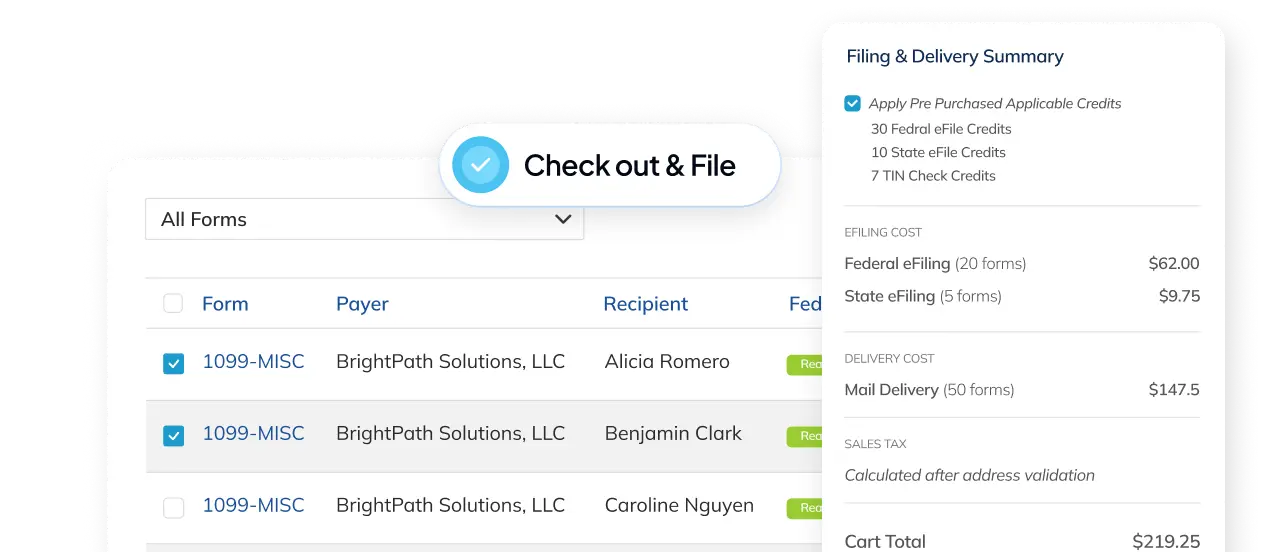
How do I file a 1099-MISC in Adams Tax Forms Helper?
Adams® Tax Forms Helper® is an authorized IRS eFile provider. Enter your payer and recipient information, fill in the applicable boxes with the correct payment amounts, and eFile directly to the IRS through IRIS. Tax Forms Helper generates Form 1096 automatically and transmits it with your 1099-MISC filings.
See About eFiling for step-by-step eFiling instructions.
Subject to change. Verify at IRS.gov or the relevant government site.
FAQs
What is the difference between Form 1099-MISC and Form 1099-NEC?
Form 1099-NEC reports contractor and nonemployee compensation for services. Form 1099-MISC reports everything else: rent, royalties, prizes, medical payments, and the other specific categories on the form. The deadline structure differs too: the 1099-NEC has one date covering all copies and filing methods, while the 1099-MISC splits into four separate deadlines depending on the box and the filing method.
What are the 1099-MISC reporting thresholds for the 2026 tax year?
The One Big Beautiful Bill Act raised the general threshold from $600 to $2,000, applying to Boxes 1, 3, 6, 9, 10, and 11. Box 2 royalties and Box 8 substitute payments keep a $10 threshold, set separately by statute and unchanged by the OBBBA. Box 4 backup withholding must be reported regardless of amount. The $2,000 threshold applies per payee, per calendar year.
Do you file a 1099-MISC for payments to a corporation?
Generally no, but two boxes on this form override the corporate exemption. Box 6 medical and health care payments apply to incorporated providers as well as individuals, and Box 10 gross proceeds paid to an attorney apply regardless of corporate structure. Rents in Box 1 paid to corporations are generally exempt. Confirm the payee's tax classification on their W-9 before filing.
What are the 1099-MISC filing deadlines for the 2026 tax year?
Four dates apply. Furnish Copy B to most recipients by February 1, 2027, and by February 16, 2027 for Box 8 and Box 10 only. File Copy A with the IRS on paper by March 1, 2027, or electronically through IRIS by March 31, 2027. The extended eFile deadline applies only to your IRS copy; recipients still need their Copy B by the earlier date.